
Dear Clients & Friends,
Due to the need for validation of our data, this weekend’s reading comes to you a little late. But, better late than even later.
With the election rapidly approaching, we’d like to focus on what is most applicable to our role as wealth managers - the economy.
As was the case four years ago, it is difficult to produce a side-by-side comparison of the Republican and Democratic candidate’s economic platforms because their respective plans are detailed in vastly different ways. Trump’s plan is more of a vision rather than a list of actionable steps. Biden’s platform is composed of specific, actionable ideas and various detailed subcategories of economic reform. Therefore, some of our analysis is based on the specifics put forth by the candidates (where available), some is based on the general economic theory put forth by the two political parties over the last 40 years, and some is based on what Trump has instituted during his current tenure.
Prefaces
1) Here at MORWM, we are financiers. The following is intended to be non-partisan; our opinion is based in fact, economic history, and academic theory.
2) We live in a world where many people believe they are qualified to form their own conclusions on a topic in which they have very little formal education. Furthermore, there appears to be far more misinformation spread on social media than there is fact-based analysis produced by experts. When experts do produce thesis, they are often dismissed by readers who are suffering from selection bias; this bias is rampant on social media.
“Selection bias is the selection of data for analysis in such a way that proper randomization is not achieved, thereby ensuring that the sample obtained is not representative of the population intended to be analyzed. The phrase "selection bias" most often refers to the distortion of a statistical analysis, resulting from the method of collecting samples. If the selection bias is not taken into account, then some conclusions of the study may be false.”
These days, you can easily employ Google to find an article that opposes what you wish to oppose, and supports what you wish to support. In fact, Google does this for you. Depending on your search history, Google will attempt to return a search query that it thinks you will want to read. It is our responsibility to determine the accuracy and legitimacy of the results we find.
3) We know that a lot of you have already voted. What we’ve prepared below is still very important.
4) We thought that our readers would find it interesting to know the political affiliation of our clientele. Though we’ve not conducted a formal poll, we estimate that 70% of our clientele identifies as liberal, while 30% identifies as conservative. Surprisingly, we’ve also found that approximately 50% of our conservative clientele plan to vote for the candidate who opposes Trump. I’ve worded that very carefully, because their vote is less for Biden than it is to oppose Trump. I find that fascinating. Nonetheless, our audience’s opinion bears no weight on our analysis or conclusion.
Now, let’s get into it…
Trump Campaign Economic & Tax Plan
“President Trump is working hard to implement his ‘America First’ platform, continuing his promise to the American people to lower taxes, repeal and replace Obamacare, end stifling regulations, protect our borders, keep jobs in our country, take care of our veterans, strengthen our military and law enforcement, and renegotiate bad trade deals, creating a government of, by and for the people. He is making America First, again, restoring our nation’s faith, ushering in a bright, new future now and for generations to come.”
This is the extent of Trump’s economic proposal. There are no actionable steps, only this vision. The vision is very encouraging. However, it is difficult to evaluate the practicality of accomplishing this vision without a road map to the finish line.
At the National Convention, Trump proposed an unspecified tax cut to boost take-home pay and an unspecified “Made in America” tax credit. These ideas have not been formalized and are not mentioned on Trump’s website. Additionally, he proposed to expand Opportunity Zones, which is a program created to spur investment in economically distressed census tracts. The incentive provides capital gains and tax relief for investors in qualified opportunity zones.
For more, we can turn to Trump’s official campaign website which is quoted below, followed by commentary on each item:
“Under President Trump’s leadership, Congress passed historic tax cuts and relief for hard-working Americans. The Tax Cuts and Jobs Act:”
- Is the first major tax reform signed in 30 years.”
Below is a list of tax reforms over the last 30 years. Please decide for yourself if these were “major” or “minor"
American Taxpayer Relief Act of 2012
Tax Relief, Unemployment Insurance Reauthorization, & Job Creation Act of 2010
Jobs and Growth Tax Relief Reconciliation Act of 2003
Economic Growth and Tax Relief Reconciliation Act of 2001
Internal Revenue Service Restructuring Act of 1998
Taxpayer Relief Act of 1997
Taxpayer Bill of Rights 2 of 1996
Omnibus Budget Reconciliation Act of 1993
Omnibus Budget Reconciliation Act of 1990
- “Provided tax relief for 82% of middle-class families.”
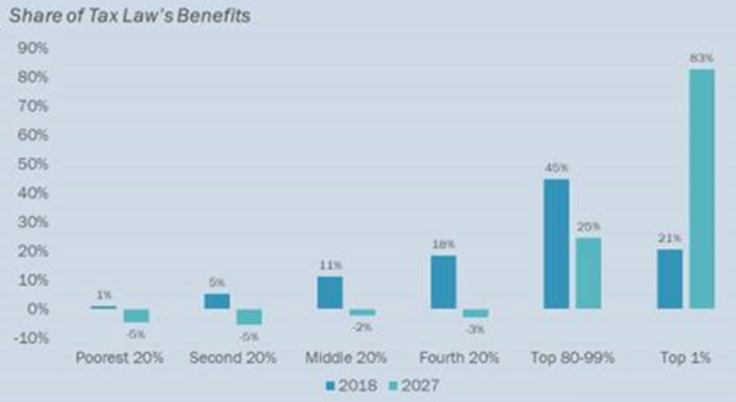
This is true, and it is very supportive of trickle-down economics. According to the Budget Policy Center, two thirds of this tax cut benefit the top one fifth of American wealth, and only 17% was felt by the bottom 60% of American wealth. By 2027, 83% of the financial benefit of this tax reform will be felt by the top 1% of wealth in America. While this is only a prediction, the question here is whether or not you believe in trickle-down economics, and if the benefit will trickle down to the working class in time. More on that later…

Budget Policy Center 2/2019
- “Doubled the Child Tax Credit proving an additional $1,000 per child in tax relief for working parents.”
We think there is a typo of Trump’s website. We assume he meant “providing” not “proving”. Regardless, we think this was an excellent move.
- “Nearly doubled the standard deduction, a change that simplified the tax filing process for millions of Americans.”
For many people, this was a very good deal. By doubling the standard deduction, those that use the standard deduction simply got a bigger deduction. Many that previously itemized found it more beneficial to use this new higher standard deduction, thereby saving money in taxes, as well as simplifying their returns because they did not need to itemize.
On the other hand, many that did itemize lost a tremendous number of itemized deductions, the biggest of which was the SALT tax deduction. Before Trump’s tax reform, State And Local Taxes (which are a large portion of many people’s annual expenses) were deductible on your federal return. No longer able to deduct most state, local, and real estate taxes, many Americans found themselves paying significantly more in aggregate taxes after this reform was passed. So, this part of the reform helped low-income earners, was neutral or bad for middle-income earners depending on what state one lives in, and hurt high-income earners.
- “Cut taxes for small business by 20%, providing $415 billion in tax relief for small business owners.”
This is a tough one. It’s very unclear what is considered to be a “small business” according to the Trump administration. But the Senate (which is controlled by the Republican party) wrote a paper in 2017 in which they surveyed how small business owners felt about the tax proposal. Here are the results:

- “Alleviated the tax burden on over 500 companies. who (sic) used those savings to fund bonuses, wage increases for 4.8 million workers.”
Another typo here. “W” should be capitalized. Just pointing this out so our readers don’t think it’s our typo.
There is no context here. However, if 500 companies were made up of 5 million workers, each company would have 10,000 employees. Many would say that these are not small businesses. Therefore, I’m not sure that this is relevant.
“Spurred new investments into the American economy, after it was passed businesses invested $482 billion into new American projects.”
I’m not sure what, specifically, this is referring to. This sentence is grammatically incorrect.
- “Repealed Obamacare’s burdensome individual mandate.”
This is a very interesting point, and is best left for a separate conversation on healthcare. That being said, emergency medical care is rendered free by eliminating the mandate. If an uninsured accident victim visited the hospital without having insurance, they would be cared for - even though the vast majority could not afford that care. By eliminating the mandate, emergency medical care became a public service for those without insurance. This conflicts directly with Trump’s opposition to free handouts. Very interesting concept…
- “Made U.S. companies competitive on the world stage, lowering the corporate tax rate from one of the highest in the industrialized world (35%) to 21%.”
This is an extremely good idea if you believe in trickle-down economics. A very small percentage of companies in America actually pay the corporate tax rate; most small businesses pay a pass-through tax on their individual return. Those that pay the corporate tax rate are medium- and large-sized businesses. Large businesses benefited the most, by far, from this reform. Thus, it’s a tax break for the largest companies; this break would (hopefully, theoretically) trickle down to employees, clients, and small business partners of the larger corporations.
We will discuss trickle-down economics in the third section. But for now, let’s move on to Joe Biden.
Biden Campaign Economic & Tax Plan
Joe Biden, along with the majority of candidates in the Democratic primary, believes that the ultra-rich should be paying more in taxes. It’s trickle “up” economics.
- No additional personal taxes on any American making less than $400,000 per year
By reading in between the lines, it appears that he is referring to families making less than 400k a year, rather than individuals. It’s hard to say at this moment, but that’s our assumption. If we are correct, we assume taxes will not go up on families making less than 400k and individuals making less than 300k-ish.
- Raising the corporate tax rate to 28 percent.
“Trickle-Up Economics”
- “Requiring a true minimum tax on ALL foreign earnings of United States companies located overseas so that we do our part to put an end to the global race to the bottom that rewards global tax havens. This will be 21% — TWICE the rate of the Trump offshoring tax rate and will apply to all income.”
There has been little conversation on this one, and little context on how to implement and monitor it. To be frank, there are so many loopholes in prior legislation that this could take an entire two-term presidency to fix. Congress must be on board, and it would take a corporate culture shift in order to implement it. It’s a good idea - in theory.
- “Imposing a tax penalty on corporations that ship jobs overseas in order to sell products back to America.”
Again: this is a good idea, but it would be nearly impossible to enforce. It also violates the idea of pure free trade. Then again, a lot of good ideas (such as pollution control) violate pure free trade.
- “Imposing a 15% minimum tax on book income so that no corporation gets away with paying no taxes.”
This is a fascinating topic and deserves its own article altogether. “Book income” is a term for the profits that are reported to shareholders. Many large corporations report very little taxable income because they reinvest this income (which is a taxable expense), reducing taxable net income dramatically. A criticism of this type of tax is that it could decrease research and development, which is the driving force of innovation. On the other hand, an endless tax expense allowance for research and development allows mega corporations to grow extremely rapidly while paying very little in taxes. The result is that the growth rate of mega corporations like Amazon threatens competition by small and mid-size businesses. A blanket 15% book tax is probably a terrible idea. But the concept of a book tax is pro-competition, anti-monopoly/duopoly, and attempts to institute a minimum tax on companies whose stock prices are through the roof.
A recent update suggests that Biden would only enforce this minimum tax on corporations with book income exceeding $100M.
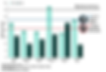
Below is a good summary compiled by S&P Global Market Intelligence, which shows the difference in tax liability between the tax rate pre-Trump (black line), Trump’s current tax policy (red line), and Biden’s proposed tax policy (blue line). The chart also shows the tax percentage liability for six huge tech companies in 2016 (pre-Trump) and 2019 (during Trump).
- “Raising the corporate tax rate to 28 percent.”
“Fair Share”, “trickle-up”
- “Raising the top individual income rate back to 39.6 percent.”
Very much trickle-up economics.
- Asking those making more than $1 million to pay the same rate on investment income that they do on their wages.
Stated more clearly, this would raise the income tax rate on investment dividends to the earned income rate. Currently, the highest tax rate of qualified dividends is 20%. Biden’s proposal would reclassify dividend income as earned income (which has a higher tax rate) for those making more than $1,000,000 in annual income. Again, this is trickle up economics. Conceptually, the ultra-wealthy would pay a little more in taxes in order to help American workers who have income levels more commensurate with nurses, schoolteachers, etc.
- There are a number of other initiatives that Biden has discussed. We have listed some of these below without comment. All are directly aimed at lower income earners and small businesses.
Expands the Earned Income Tax Credit (EITC) for childless workers aged 65+; provides renewable-energy related tax credits to individuals.
Expands the Child and Dependent Care Tax Credit (CDCTC) from a maximum of $3,000 in qualified expenses to $8,000 ($16,000 for multiple dependents), and increases the maximum reimbursement rate from 35 percent to 50 percent.
Reestablishes the First-Time Homebuyers’ Tax Credit, which was originally created during the Great Recession to help the housing market. Biden’s homebuyers’ credit would provide up to $15,000 for first-time homebuyers.
Offers tax credits to small businesses for adopting workplace retirement savings plans.
The Tax Foundation is an independent tax policy nonprofit. They report that Biden’s plan would raise tax revenue by $3.05 trillion over the next decade on a conventional basis. When accounting for macroeconomic feedback effects, the plan would collect about $2.65 trillion over the next decade. This is lower than they originally estimated due to the revenue effects of the coronavirus pandemic, the economic downturn, and new tax credit proposals introduced by the Biden campaign.
The Tax Foundation tends to lean conservatively. However, they have not reported on Trump’s tax plan because his plan is a vision of the end result without a formal strategy to get there.
Trickle-Up or Trickle-Down:
Perhaps the most notable discussion is not about Trump’s plan vs. Biden’s plan, but rather, is an assessment of what “trickle” economics is, and which party supports northbound or southbound trickling. It may surprise many people to learn that the term “Trickle-Down Economics” originated as a joke by the comedian Will Rogers. The term often generates criticism over policies that favor the wealthy, but are framed as beneficial for the average citizen. The term was first used in politics during the Reagan administration when they reduced the highest tax bracket by 20% while reducing the lowest tax bracket by only 3%.
Simply put (and this is one of our typical over-simplifications), trickle-down economics implies that if you give wealthy people and large business owners tax relief, they will spend more money and hire more employees - both of which stimulate the economy. Theoretically, the benefit will trickle down to everyone else- more people with jobs, more people with money to spend on goods, etc. Furthermore, the tax cuts for the wealthy would pay for themselves in time, when a stronger economy results in more tax dollars collected despite a lower tax percentage applied.
On the other hand, “Trickle-Up Economics” is the idea that increasing the disposable income of the majority of Americans (the bottom 80-90%) will promote consumption. The business owners, who tend to be among the wealthier class, would benefit from having more clients buying more goods.
Bam, it’s as simple as that. There is the economic side of trickle-down economics, and there is the social side. We will leave the social assessment out for now. Obviously, taking care of those less fortunate is inscribed in nearly every religious text we know about. On the other hand, sometimes we need to make tough choices - painful in the short term, but beneficial in the long term.
All we have to go on is historical fact. The fact is that trickle-down economics has not worked, ever. In addition, trickle-up economics hasn’t really been studied. The Wharton School of Business published a widely respected paper in 2017, arguing that lower taxes on the wealthy do not pay for themselves with increased tax collections resulting from a stronger economy. Interestingly, George HW Bush referred to trickle-down economics as “Voodoo” economics.
The following is not opinion - it is data. Reagan oversaw a significant economic decline and a recession that lasted 2 years in the early 80s. It’s difficult to assess how much of this was due to the tax reform, or to the disruption in the oil supply in the late 70s and early 80s. We also know that, over the last 60 years, Republican presidents have overseen lower GDP, lower GDP growth rates, more recessions, and less recoveries than a Democratic president, all of which we’ve written about and footnoted in previous articles. Economics may not be as important to some voters as health-related issues, education related concerns, or any number of other topics of interest. In terms of economic theory, however, trickle-down economics simply does not hold water. If that is important to you as a reader, then certainly take that into consideration.
Trickle-up economics is also not proven to work. However, a close companion to trickle-up economic research is the research conducted on the negative financial impact of the global wealth gap. And this has been studied repeatedly. Trickle-down economics, by its very definition, inflates the wealth gap. When people can’t take care of themselves, they become a burden on the system that we all use. That is the financial problem with the wealth gap.
In conclusion:
We, as financial professionals with years of academic training and industry experience, believe that Biden’s plan deserves a B, while Trump’s plan deserves a C- (it would be a D+ when you take the social effects into consideration). We do not think either side has a great plan; we’ve simply graded the two for the sake of comparison.
That being said, we hope that, if you’ve taken any knowledge from this article, it is that trickle-down economics, also referred to as supply-side economics, really has no historic value. This is something we have spent two decades trying to teach people. Beyond that, we hope that this article gives insight into each candidate’s economic vision/plan, and that it helps cut through the mind-numbing amount of noise that exists in modern media.
We wish you all a great weekend, and no matter who you vote for, VOTE!
Your MORWM family
Matthew Ramer, AIF®
Principal, Financial Advisor
MOR Wealth Management, LLC
1801 Market Street, Suite 2435
Philadelphia, PA 19103
P: 267.930-8301 | c: 215-694-4784 | f: 267.284.4847 |
601 21st Street, Suite 300
Vero Beach, FL 32960
P: 772-453-2810
matthew.ramer@morwm.com | www.morwm.com
The majority of this content was written and distributed MOR Wealth Management, all rights reserved. Securities and advisory services offered through Commonwealth Financial Network, Member FINRA/SIPC, a registered investment adviser. Fixed insurance products and services offered through CES Insurance Agency.